
Streaming trends 2026 show an industry that looks noticeably different from just a year or two ago. Behind the scenes, it has been reshaped by a historic acquisition battle, tighter password-sharing enforcement, rising subscription prices, and a decisive shift of live sports onto internet platforms.
This article breaks down the streaming trends 2026 has brought so far — not speculative predictions, but developments that are already changing what you watch, how much you pay, and who owns the platforms behind your favorite shows. Whether you’re a casual viewer or someone who tracks the streaming trends 2026 closely, here’s what’s actually happening and what it means for you.
Table of Contents
What’s Driving Streaming Trends 2026?
A few forces are converging at once: streaming companies are under pressure to turn subscriber growth into consistent profit, traditional media companies continue merging or restructuring, and viewers are increasingly price-sensitive after years of subscription cost increases. Together, these pressures explain most of the biggest headlines of 2026.
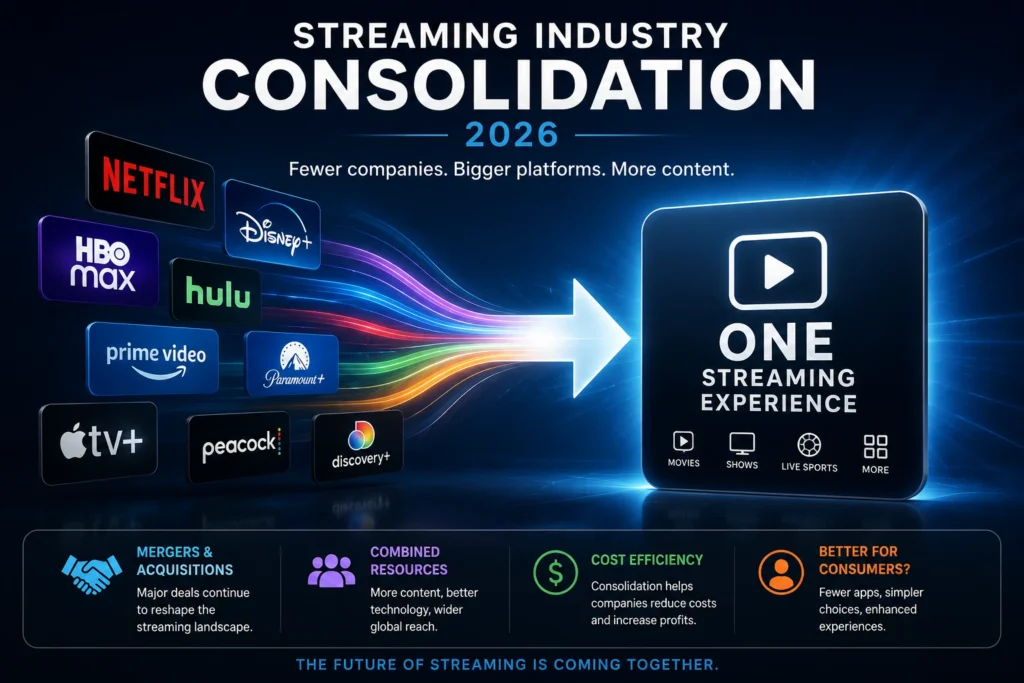
1. Industry Consolidation Leads Streaming Trends 2026
The single biggest business story in streaming this year has been the fight over Warner Bros. Discovery (WBD). In December 2025, Netflix agreed to acquire WBD’s studio and streaming assets, including HBO and HBO Max, in a deal valued at roughly $82.7 billion. Netflix later amended the agreement to an all-cash offer of $27.75 per share to strengthen its position, as detailed in the official Netflix announcement.
Paramount Skydance continued pursuing WBD with a rival offer throughout early 2026. In February 2026, WBD’s board determined that Paramount’s revised bid, valuing the company at roughly $111 billion including debt, was superior, and Netflix chose not to match it. WBD shareholders approved the Paramount deal in April 2026, and it received Department of Justice approval the following month.
The deal has not closed without resistance. In July 2026, attorneys general from a group of states sued to block the acquisition, arguing it would reduce competition in film distribution, cable, and streaming. A federal judge issued a temporary restraining order pausing the closing while the case proceeds, and regulatory reviews in the European Union and United Kingdom remain ongoing.
Why Consolidation Matters for Viewers
When major studios and streaming platforms merge, it typically affects content licensing, app consolidation, and pricing over time. If the Paramount-WBD deal ultimately closes, expect gradual changes to how HBO Max content is bundled and priced, though nothing has been finalized while litigation is pending.
2. Password-Sharing Crackdowns Define Streaming Trends 2026
What began as a controversial experiment has become routine across the industry. Netflix pioneered strict household-based enforcement, using IP addresses, device IDs, and account activity to define who can access an account without extra charges, as explained in Netflix’s own Help Center article on the Netflix Household policy. Viewers who want to share access outside their household can add extra member slots for an additional monthly fee.
Disney followed a similar path, applying household restrictions to Disney+ and Hulu. HBO Max began enforcing its own password-sharing policy in the U.S. in August 2025, with Warner Bros. Discovery indicating in February 2026 that a global rollout would continue through the year.
What This Means If You Share an Account
If you’ve shared streaming logins with friends or family outside your home, expect continued restrictions across most major platforms. The practical options are usually to pay for an official extra-member add-on where available, or to have each household maintain its own subscription. For a closer look at optimizing your own streaming setup, see our guide on [INTERNAL LINK: Best IPTV Apps for Android TV].
3. Ad-Supported Tiers Are the New Growth Engine in Streaming Trends 2026
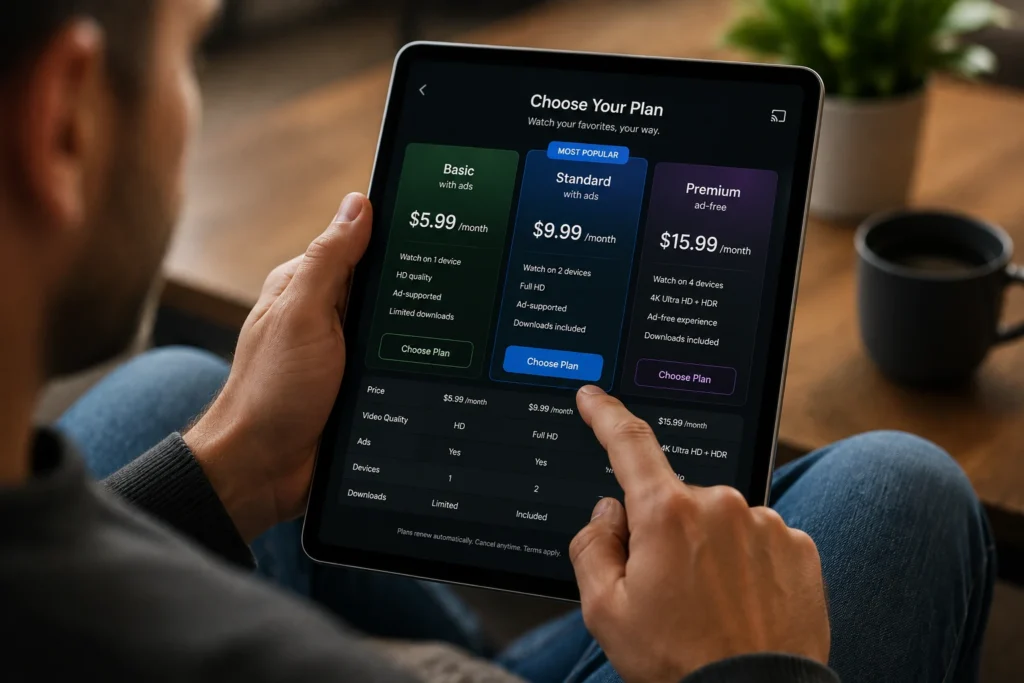
As subscription prices have climbed, ad-supported plans have become the primary lever platforms use to keep new subscribers coming in. Netflix, for example, raised its prices again in early 2026, with its ad-supported plan, Standard tier, and Premium tier all increasing in the U.S. Every major SVOD platform, including Disney+, Max, and Amazon Prime Video, now offers some form of ad-supported option.
This shift reflects a broader pattern: platforms are using price increases on ad-free tiers to nudge cost-sensitive viewers toward cheaper, ad-supported plans rather than losing them entirely.
What to Consider Before Choosing a Plan
- Compare the price difference between ad-supported and ad-free tiers on each platform you use
- Check whether ad-supported plans restrict video quality or simultaneous streams
- Reassess your subscriptions periodically, since pricing and tier features change more often than in past years
4. Live Sports Continues Its Move to Streaming
Live sports rights have increasingly shifted from traditional cable broadcasts to streaming platforms over the past several years, and 2026 has continued that trajectory. Major sports leagues and broadcasters are placing more games behind streaming apps and hybrid bundles rather than relying solely on cable distribution.
For viewers, this means live sports increasingly require a mix of subscriptions rather than a single cable package, which has fueled continued interest in legal streaming bundles that consolidate multiple services. It has also intensified anti-piracy enforcement around major sporting events, since unauthorized streams tend to spike in popularity whenever high-profile games move behind new paywalls.
5. FAST Channels Keep Filling the Gaps
Free Ad-Supported Streaming Television (FAST) channels have continued expanding in 2026, giving viewers a no-cost, ad-supported alternative alongside paid subscriptions. Major publishers and broadcasters have launched their own branded FAST channels this year, adding to the free content already built into most smart TV platforms. We’ve covered this in more depth in our guide on [INTERNAL LINK: Latest IPTV Trends in 2026: What Has Changed?] and our recent [INTERNAL LINK: IPTV Industry News Roundup].
6. AI-Driven Personalization and Content Authenticity
Two related technology trends are shaping the back end of streaming platforms this year. First, AI-driven personalization has moved from a competitive advantage to a baseline expectation, with platforms using viewing data to tailor recommendations, artwork, and even promotional messaging to individual viewers.
Second, content authenticity and provenance tools, particularly the C2PA (Coalition for Content Provenance and Authenticity) standard, are beginning to appear across streaming production and distribution workflows. These tools aim to verify that video content hasn’t been manipulated or misrepresented, a growing concern as AI-generated video becomes more common. You can learn more about the underlying framework through the official C2PA specification.
7. YouTube’s Growing Role in the Living Room
YouTube has continued expanding its share of television viewing time, increasingly competing directly with traditional SVOD platforms for living-room attention. Longer-form content, licensed classic titles, and creator-driven programming have all contributed to YouTube capturing more household viewing hours, particularly on smart TVs rather than mobile devices.
8. Streaming Bundles Are Becoming the Norm
Another theme running through streaming trends 2026 is the return of bundling — but in a very different form than traditional cable packages. Rather than one all-in-one cable bill, viewers are increasingly offered bundles that combine multiple streaming services, mobile phone plans, or internet packages at a discounted rate.
Telecom providers and device platforms are also pushing toward what the industry calls “super-aggregation” — building a single home screen or interface that pulls together live TV, on-demand libraries, and FAST channels from multiple sources in one place. This mirrors what smart TV platforms like Roku, Samsung TV Plus, and LG Channels already do with free content, but extends the concept to paid subscriptions as well.
Why Bundling Matters for Your Wallet
Bundled offers can reduce your total monthly streaming spend, but they can also make it harder to track exactly what you’re paying for each individual service. Before accepting a bundle, it’s worth checking:
- Whether the bundle includes services you actually use regularly
- If the discounted rate is locked in or subject to increase after an introductory period
- Whether canceling one service in the bundle affects pricing on the others
What Streaming Trends 2026 Mean for Viewers
| Trend | What’s Changing | Practical Impact |
|---|---|---|
| Industry consolidation | Major studios merging or restructuring | Content licensing and app bundling may shift over time |
| Password-sharing crackdowns | Household-based enforcement across platforms | Sharing outside your home now usually costs extra |
| Ad-supported tier growth | Ad-free prices rising, ad tiers expanding | More affordable options exist if you’re willing to see ads |
| Live sports migration | More games moving to streaming apps | You may need multiple subscriptions for full sports access |
| FAST channel growth | More free, ad-supported linear channels | More free content without new subscriptions |
| AI and content authenticity | Personalization and provenance tools maturing | More tailored recommendations; more verified content over time |
Tips for Navigating Streaming Trends 2026
- Audit your subscriptions quarterly. Prices and tier features change more frequently than before, so a plan that was the best value six months ago may not be anymore.
- Consider ad-supported tiers strategically. For casual viewing, the savings often outweigh the trade-off of watching ads.
- Keep an eye on merger news if you’re a heavy HBO Max or Warner Bros. content viewer. Pending litigation means changes to that platform are not yet finalized.
- Use official household management tools rather than informal workarounds to avoid unexpected account lockouts.
- Take advantage of FAST channels for background or casual viewing instead of adding another paid subscription.
Frequently Asked Questions About Streaming Trends 2026
1. Did Netflix acquire Warner Bros. Discovery?
No. Netflix and WBD had a merger agreement, but WBD’s board ultimately determined that a competing offer from Paramount Skydance was superior, and Netflix withdrew in February 2026. The Paramount-WBD deal is currently subject to pending litigation.
2. Is password sharing still possible on major streaming platforms?
Most major platforms, including Netflix, Disney+, Hulu, and HBO Max, now enforce household-based restrictions. Sharing outside your household typically requires an official extra-member add-on where available.
3. Why do so many streaming services now have ads?
Ad-supported tiers allow platforms to offer lower prices while generating advertising revenue, making them a key growth strategy as subscription prices on ad-free tiers continue to rise.
4. Are live sports moving away from cable completely?
Not entirely, but a growing share of live sports rights have shifted to streaming platforms, often requiring viewers to subscribe to multiple services for full coverage.
5. What is a FAST channel?
FAST stands for Free Ad-Supported Streaming Television — scheduled, linear channels delivered over the internet and funded by advertising instead of subscription fees.
6. What is C2PA and why does it matter for streaming?
C2PA is a content authenticity standard designed to verify whether video content has been altered or AI-generated, an increasingly important tool as synthetic media becomes more common.
7. Will streaming prices keep going up?
Recent history suggests continued price adjustments are likely, though the pace and structure vary by platform. Comparing ad-supported and ad-free tiers can help offset rising costs.
8. Are streaming bundles worth it in 2026?
They can be, especially if the bundled services match what you already watch. Review the terms carefully, since introductory pricing on bundles often increases after a set period.
9. How is AI changing what I see on streaming platforms?
AI is primarily used for personalized recommendations, thumbnail selection, and content organization. Its role in detecting AI-generated or manipulated video, through frameworks like C2PA, is also growing as a separate but related trend.
Final Thoughts on Streaming Trends 2026
Streaming trends 2026 tell a consistent story: an industry consolidating at the business level while pushing viewers toward household restrictions, ad-supported plans, and fragmented live sports access. None of these shifts are purely negative — ad tiers and FAST channels genuinely expand affordable options — but they do require more active management of your subscriptions than in years past.
Understanding streaming trends 2026 now can save you money and frustration later, especially as mergers, pricing, and password policies keep evolving. To stay current on how these industry-wide changes intersect with IPTV and streaming technology specifically, explore our related guides on [INTERNAL LINK: Latest IPTV Trends in 2026: What Has Changed?] and [INTERNAL LINK: How to Choose a Legal IPTV Service], and check back for our next roundup of what’s changed.